Skip to content

Command Palette

Search for a command to run...

Rohan Kumar

Rohan Kumar

AI / ML EngineeringFull-Stack Systems

I build machine learning models, AI agents and the web applications around them. Each project is designed, implemented, evaluated and deployed, from Kaggle competition work to full-stack systems.

Resume / CV

01 / Selected work

Systems that ship.

Four case studies from real repositories — every link verified, every metric taken from source. Open a case study for architecture and decisions.

01

AI Agents · LLM Systems

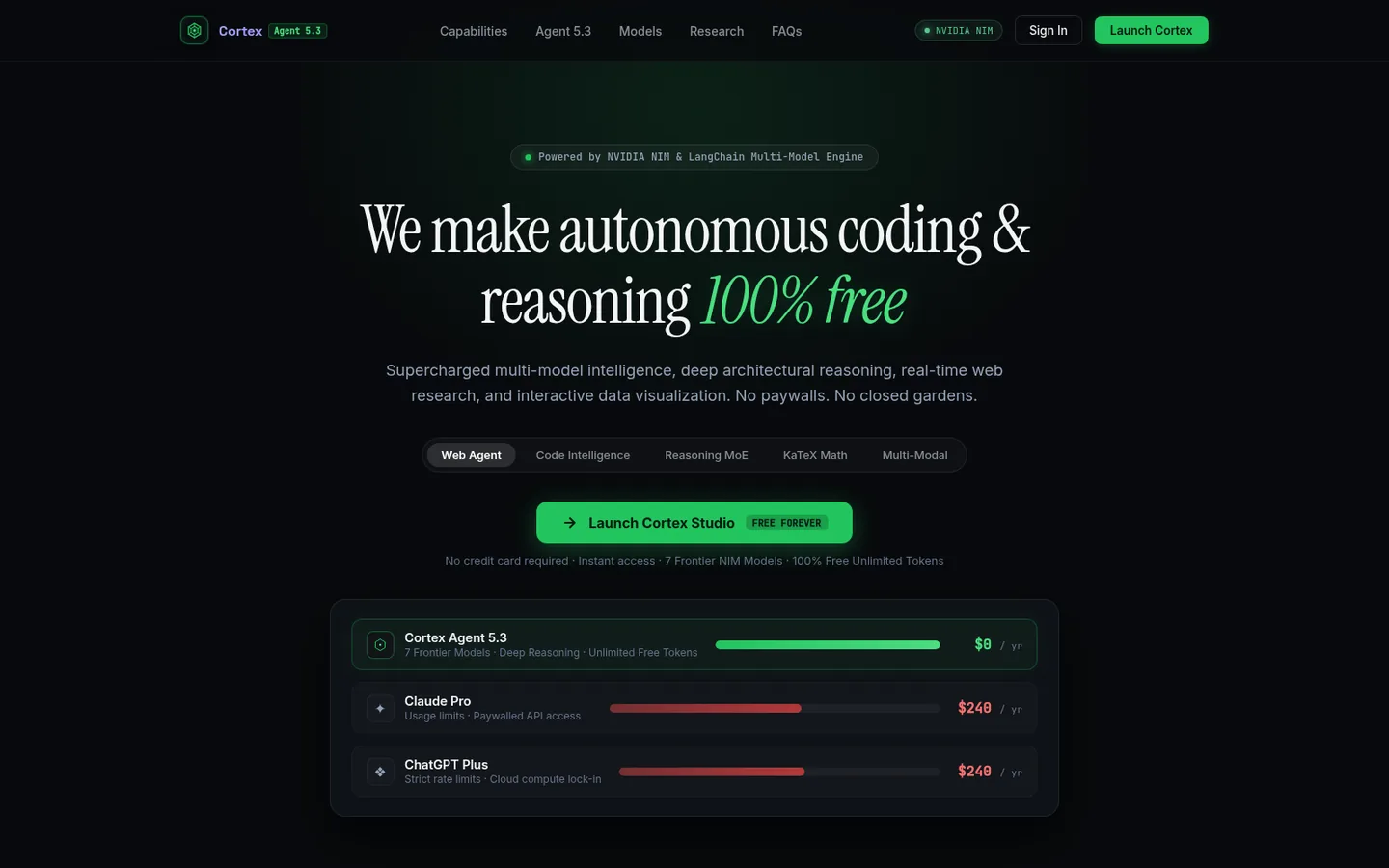
Cortex Agent

An autonomous multi-model AI agent studio, built on NVIDIA NIM frontier models.

Problem
Hosted chat UIs cap context, hide tool use, and trap artifacts inside the conversation.
Solution
An autonomous agent studio — a ReAct loop running real tools, streamed into a Claude-style artifacts canvas.
Engineering
FastAPI gateway over NVIDIA NIM (1M-token context), 7 tools, SQLite WAL, SSE heartbeat multi-tab sync, PBKDF2 + HMAC auth, daily token quotas.
Result
Deployed at cortex-agent-tawny.vercel.app with automated test suites covering auth, tools and sync.

1M

Max context window

128K

Max output tokens

7

Autonomous tools

  • FastAPI
  • LangChain
  • NVIDIA NIM
  • SQLite WAL
  • SSE
  • Vanilla JS
Cortex Agent landing page — autonomous multi-model AI agent studio
NostalgiaNet++ — a digital time capsule for the moments that matter

02

Product · Full-Stack

NostalgiaNet++

A digital time capsule — seal memories now, unlock them years from now.

Problem
Memory apps are photo dumps. A time capsule's whole point is a lock enforced by software — not hidden with CSS.
Solution
Seal photos, videos and letters inside TimeVaults with future unlock dates — group invites pre-seal, public discovery, unlock-day notifications.
Engineering
Next.js App Router + Prisma/PostgreSQL (Neon), NextAuth (bcrypt + OAuth), byte-signature upload validation, server-side sealed-content redaction on every route.
Result
Live at nostalgia-net-silk.vercel.app — runs entirely on free tiers, $0/month infrastructure.
  • Next.js
  • TypeScript
  • Prisma
  • PostgreSQL
  • NextAuth
  • Vercel Blob

03

Deep Learning · IIT Madras

Smart MCQ Solver

A 4-model ensemble for 5-option multiple-choice QA — scored by MAP@3.

Problem
5-option MCQ ranking scored by MAP@3 — while duplicated questions pushed naive local validation to a perfect ~1.0.
Solution
Four deliberately diverse models — TF-IDF+LogReg, a from-scratch BiLSTM, fine-tuned DeBERTa-v3-small and RoBERTa-base — fused by weighted rank voting.
Engineering
Leakage audit (242 duplicate train rows, 267 train/test overlaps), W&B-tracked training, clean src/ pipeline, Gradio demo on Hugging Face Spaces.
  • PyTorch
  • Transformers
  • scikit-learn
  • Weights & Biases
  • Gradio

Result — verified leaderboard · MAP@3

  • TF-IDF + LogReg0.0000
  • BiLSTM (from scratch)0.0000
  • DeBERTa-v3-small0.0000
  • RoBERTa-base0.0000
  • Weighted ensemble0.0000

Verified from the repository README. Bar scale runs 0.70 → 0.77 to make differences visible. Ensemble beats every single model.

04

Examination Management Portal

Backend Systems · Flask

Institution-grade exam lifecycle with zero client-side JavaScript.

Problem
Exam administration fails at the edges: double-booked seats, vague grading criteria, unaudited admin overrides.
Solution
A 3-role exam lifecycle platform — RBAC with approval gates, dynamic rubric grading, concurrency-safe slot booking.
Engineering
100% server-rendered PRG (zero client JS), atomic seat decrement with seat recovery, schema-level constraints, BookingHistory audit log, REST /api/v1.
Result
11/11 automated tests passing — auth, RBAC isolation, concurrency, cancellation, grading.
  • Flask 3.1
  • SQLAlchemy 2.0
  • SQLite
  • Bootstrap 5
  • Jinja2
GitHub

Competitions

Smart MCQ Solver Challenge: pick the top 3 of 5 options, scored by MAP@3.

ModelApproachMAP@3
TF-IDF + Logistic RegressionBaseline0.7511
BiLSTM (from scratch)Sequence model0.7540
DeBERTa-v3-smallFine-tuned transformer0.7544
RoBERTa-baseFine-tuned transformer0.7544
Weighted rank-vote ensembleAll four combined0.7602

02 / About

I don't stop at notebooks.

I'm a third-year B.S. Data Science & Applications student at IIT Madras, and I spend most of my time doing the same thing: taking an idea from a rough problem statement to a system that actually runs — designed, implemented, evaluated, and deployed. Each project has real architecture, tests, and a live URL where possible.

My work sits where machine learning meets software engineering. On the ML side that means building models the honest way — baselines first, leakage audits, leaderboard-anchored evaluation — like my Smart MCQ Solver, where a four-model ensemble beat every individual model. On the engineering side it means agents with real tool loops, concurrency-safe booking systems, JWT stateless APIs, and background job pipelines.

I'm drawn to AI/ML engineering and full-stack development for the same reason: both reward fundamentals over hype. I like free-tier deployments, boring databases, and code someone else can actually read. Currently deepening applied ML — and taking every project from notebook to a system that actually runs.

Stack I use

Languages, frameworks and tools across ML pipelines and full-stack apps.

  • Python
  • PyTorch
  • scikit-learn
  • FastAPI
  • Flask
  • Next.js
  • React
  • Vue.js
  • TypeScript
  • PostgreSQL
  • SQLite
  • Redis
  • Tailwind
  • Git
  • Linux

04 / Engineering approach

Idea to deployment, on purpose.

I like building end-to-end systems rather than isolated notebooks — the same loop, every time, from framing to a live URL.

  1. 01

    Idea

    Interrogate the actual constraint before touching code. What breaks today, for whom, and what would 'solved' measurably mean?

  2. 02

    System design

    Design the data model and boundaries first — schemas, state machines, contracts. Most late bugs are early decisions.

  3. 03

    Implementation

    Build the thinnest honest version end to end: real auth, real persistence, real errors. No mock stages that never ship.

  4. 04

    Evaluation

    Tests for the edges that matter — concurrency, authz boundaries, leakage audits. Leaderboards over flattering local metrics.

  5. 05

    Deployment

    Ship it publicly, wire the cron, smoke-test the route. A system isn't finished until it's reachable.

“This person doesn't just learn technologies — they actually build systems.”

The bar I build against

05 / Code & experiments

Public by default.

Kaggle

lukerohan

Smart MCQ Solver Challenge

The IIT Madras Deep Learning course ran as a Kaggle-style competition: 5-option MCQs, scored by MAP@3. The final weighted ensemble of four models scored 0.7602 MAP@3 on the competition leaderboard — above every individual model — with the submission notebook published in the repository.

$ honest-ml note — local validation was invalidated by data leakage (242 dup rows, 267 train/test overlaps). Leaderboard was the only trusted signal.

06 / Résumé

One page. Zero fluff.

An ATS-friendly, single-page PDF generated from the same verified facts as this site — education, stack, four deeply documented projects, and a compressed view of the rest. No invented experience, no padding.

Inside the PDF

  • 01Professional summary
  • 02Education — IIT Madras
  • 03Technical skills — 6 groups
  • 044 selected projects with verified outcomes
  • 05Additional projects — 5, compressed

format: A4 · serif · selectable text · print-ready

07 / Contact

Let's build something worth deploying.

Internships, collaborations, or a hard problem you want an extra engineer on — my inbox is open and I read everything.